

Warum Hanteln mehr bewirken als Muskelaufbau
Krafttraining wird häufig mit mehr Muskelmasse, einem definierten Körper oder sportlicher Leistungsfähigkeit verbunden. Doch diese Sicht greift zu kurz. Immer mehr wissenschaftliche Erkenntnisse zeigen, dass regelmäßiges Training gegen Widerstand den gesamten Organismus beeinflusst – von Muskeln und Knochen über Stoffwechsel und Gehirn bis hin zur psychischen Gesundheit. Genau deshalb hat sich auch die Wahrnehmung in der Medizin grundlegend verändert: Krafttraining gilt heute als wichtiger Bestandteil moderner Gesundheitsförderung und wird von der WHO als feste Bewegungsempfehlung genannt.
Mehr als starke Muskeln
Die positiven Effekte beginnen zwar bei Kraft und Muskelaufbau, reichen jedoch deutlich weiter. Krafttraining verbessert sportliche Leistungen, reduziert das Risiko für Verletzungen und löst gleichzeitig zahlreiche Anpassungsprozesse im Körper aus. Mechanische Belastung wird in biologische Signale umgewandelt, wodurch Muskeln, Knochen, Sehnen und das Nervensystem langfristig leistungsfähiger werden. Gleichzeitig beeinflusst das Training hormonelle Prozesse, die Regeneration, Anpassung und Gewebeaufbau unterstützen.
Diese Mechanismen wirken nicht isoliert. Sie beeinflussen zahlreiche Körpersysteme und bilden die Grundlage für die vielfältigen gesundheitlichen Vorteile, die mittlerweile in zahlreichen Studien beschrieben werden.
Krafttraining als Gesundheitsfaktor
Die Forschung zeigt einen klaren Zusammenhang zwischen regelmäßigem Krafttraining und einer geringeren Gesamtsterblichkeit. Bereits vergleichsweise geringe Trainingsumfänge gehen mit einer deutlichen Reduktion des Sterberisikos einher.
Auch die Knochengesundheit profitiert erheblich. Regelmäßige Belastung erhöht die Knochenmineraldichte und kann insbesondere bei älteren Menschen sowie postmenopausalen Frauen das Risiko für Osteoporose und Frakturen reduzieren. Dadurch trägt Krafttraining wesentlich dazu bei, Mobilität und Selbstständigkeit bis ins hohe Alter zu erhalten.
Darüber hinaus richtet sich der Blick der Forschung zunehmend auf das Gehirn. Hinweise sprechen dafür, dass Krafttraining den altersbedingten kognitiven Abbau verlangsamen und neuronale Anpassungsprozesse fördern kann. Gleichzeitig zeigen Studien positive Effekte auf depressive Symptome und Ängste, sodass Widerstandstraining heute zunehmend als ergänzende therapeutische Maßnahme betrachtet wird.
Auch Stoffwechselerkrankungen profitieren. Krafttraining verbessert die Insulinsensitivität, unterstützt die Blutzuckerregulation und stellt einen wichtigen Baustein in Prävention und Behandlung des Typ-2-Diabetes dar.
Selbst in der Onkologie gewinnt Bewegung immer mehr an Bedeutung. Krafttraining kann während und nach einer Krebstherapie die Lebensqualität verbessern, Erschöpfung reduzieren und den Krankheitsverlauf positiv beeinflussen.
Entscheidend ist die Regelmäßigkeit
Ein wirksames Krafttraining muss nicht kompliziert sein. Wichtig sind eine individuelle Anpassung an den Trainingsstand, eine saubere Technik und eine kontinuierliche Belastungssteigerung. Für Anfänger reichen bereits moderate Belastungen, während Fortgeschrittene Intensität und Trainingsumfang gezielt steigern können. Entscheidend ist vor allem die langfristige Regelmäßigkeit, denn viele strukturelle Anpassungen entwickeln sich erst über mehrere Wochen und Monate.
Warum dieses Thema immer wichtiger wird
Mit einer alternden Gesellschaft steigen chronische Erkrankungen, Pflegebedarf und Gesundheitskosten kontinuierlich an. Krafttraining bietet hier eine vergleichsweise einfache und kosteneffiziente Möglichkeit, Gesundheit, Funktionalität und Lebensqualität langfristig zu erhalten. Es stärkt nicht nur den Bewegungsapparat, sondern unterstützt zahlreiche Körpersysteme gleichzeitig.
Doch welche Trainingsform liefert die größten gesundheitlichen Effekte?
Welche Intensität, Wiederholungszahl und Trainingsfrequenz sind wissenschaftlich tatsächlich sinnvoll?
Und welche Studien zeigen die beeindruckendsten Ergebnisse für Langlebigkeit, Demenz, Diabetes und Krebs?
Die vollständige Analyse mit allen wissenschaftlichen Hintergründen, konkreten Trainingsempfehlungen und den wichtigsten Studien findest du exklusiv in der Academy.
Dein DK Sports & Physio Team aus der Karlsruher Oststadt
Den ausführlichen Artikel findest du in unserer DK Academy.
Wir geben Physiotherapeuten, Trainern und allen Wissbegierigen einen sachlichen Einblick in die Physiotherapie und helfen so die Rehabilitation und das Training nach Verletzungen oder Beschwerden effizienter zu gestalten.
Sichere dir vollen Zugriff auf unsere Rehab Live Sessions, exklusive Review- und Blogartikel, Simple Tipps und Infografiken.
Du benötigst Physiotherapie im Raum Karlsruhe? Dann sind wir gerne für dich da und unterstützen dich!
Dein DK Sports & Physio Team aus der Karlsruher Oststadt
Unsere weiteren Blog-Artikel
Hallux Valgus – Nur ein Schönheitsmakel?
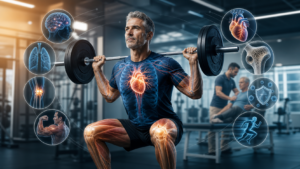
Krafttraining ist Medizin!

Post-COVID in der Physiotherapie: Sicher behandeln trotz Unsicherheit

Sarkopenie: Wie wir den Muskelschwund erkennen und stoppen
Die Königin aller Übungen – Die Kniebeuge

Schlaf Kindlein, Schlaf, warum guter Schlaf so wichtig ist!
Rotator cuff related shoulder pain – was steckt dahinter?
Quellenangaben:
[1] T. J. Suchomel, S. Nimphius, and M. H. Stone, “The Importance of Muscular Strength in Athletic Performance,” Sports Med, vol. 46, no. 10, pp. 1419–1449, Oct. 2016, doi: 10.1007/s40279-016-0486-0.
[2] L. B. Seitz, A. Reyes, T. T. Tran, E. S. De Villarreal, and G. G. Haff, “Increases in Lower-Body Strength Transfer Positively to Sprint Performance: A Systematic Review with Meta-Analysis,” Sports Med, vol. 44, no. 12, pp. 1693–1702, Dec. 2014, doi: 10.1007/s40279-014-0227-1.
[3] M. Keiner, A. Sander, K. Wirth, and D. Schmidtbleicher, “Long-Term Strength Training Effects on Change-of-Direction Sprint Performance,” Journal of Strength and Conditioning Research, vol. 28, no. 1, pp. 223–231, Jan. 2014, doi: 10.1519/JSC.0b013e318295644b.
[4] J. B. Lauersen, D. M. Bertelsen, and L. B. Andersen, “The effectiveness of exercise interventions to prevent sports injuries: a systematic review and meta-analysis of randomised controlled trials,” Br J Sports Med, vol. 48, no. 11, pp. 871–877, June 2014, doi: 10.1136/bjsports-2013-092538.
[5] J. B. Lauersen, T. E. Andersen, and L. B. Andersen, “Strength training as superior, dose-dependent and safe prevention of acute and overuse sports injuries: a systematic review, qualitative analysis and meta-analysis,” Br J Sports Med, vol. 52, no. 24, pp. 1557–1563, Dec. 2018, doi: 10.1136/bjsports-2018-099078.
[6] L. Maestroni et al., “The Benefits of Strength Training on Musculoskeletal System Health: Practical Applications for Interdisciplinary Care,” Sports Med, vol. 50, no. 8, pp. 1431–1450, Aug. 2020, doi: 10.1007/s40279-020-01309-5.
[7] G. G. Haff and M. H. Stone, “Methods of Developing Power With Special Reference to Football Players,” Strength & Conditioning Journal, vol. 37, no. 6, pp. 2–16, Dec. 2015, doi: 10.1519/SSC.0000000000000153.
[8] P. Cormie, M. R. McGuigan, and R. U. Newton, “Developing Maximal Neuromuscular Power: Part 1 – Biological Basis of Maximal Power Production,” Sports Medicine, vol. 41, no. 1, pp. 17–38, Jan. 2011, doi: 10.2165/11537690-000000000-00000.
[9] K. M. Khan and A. Scott, “Mechanotherapy: how physical therapists’ prescription of exercise promotes tissue repair,” Br J Sports Med, vol. 43, no. 4, pp. 247–252, Apr. 2009, doi: 10.1136/bjsm.2008.054239.
[10] S. J. Warden and W. R. Thompson, “Become one with the force: optimising mechanotherapy through an understanding of mechanobiology,” Br J Sports Med, vol. 51, no. 13, pp. 989–990, July 2017, doi: 10.1136/bjsports-2017-097634.
[11] M. R. Deschenes, W. J. Kraemer, C. M. Maresh, and J. F. Crivello, “Exercise-Induced Hormonal Changes and their Effects upon Skeletal Muscle Tissue:,” Sports Medicine, vol. 12, no. 2, pp. 80–93, Aug. 1991, doi: 10.2165/00007256-199112020-00002.
[12] B. Crewther, J. Keogh, J. Cronin, and C. Cook, “Possible Stimuli for Strength and Power Adaptation: Acute Hormonal Responses,” Sports Medicine, vol. 36, no. 3, pp. 215–238, 2006, doi: 10.2165/00007256-200636030-00004.
[13] P. Shailendra, K. L. Baldock, L. S. K. Li, J. A. Bennie, and T. Boyle, “Resistance Training and Mortality Risk: A Systematic Review and Meta-Analysis,” American Journal of Preventive Medicine, vol. 63, no. 2, pp. 277–285, Aug. 2022, doi: 10.1016/j.amepre.2022.03.020.
[14] E. Stamatakis et al., “Does Strength-Promoting Exercise Confer Unique Health Benefits? A Pooled Analysis of Data on 11 Population Cohorts With All-Cause, Cancer, and Cardiovascular Mortality Endpoints,” American Journal of Epidemiology, vol. 187, no. 5, pp. 1102–1112, May 2018, doi: 10.1093/aje/kwx345.
[15] F. Saeidifard et al., “The association of resistance training with mortality: A systematic review and meta-analysis,” Eur J Prev Cardiolog, vol. 26, no. 15, pp. 1647–1665, Oct. 2019, doi: 10.1177/2047487319850718.
[16] J. P. Rey Lopez, K. Gebel, D. Chia, and E. Stamatakis, “Associations of vigorous physical activity with all-cause, cardiovascular and cancer mortality among 64 913 adults,” BMJ Open Sport Exerc Med, vol. 5, no. 1, p. e000596, Aug. 2019, doi: 10.1136/bmjsem-2019-000596.
[17] P. Cormie, E. M. Zopf, X. Zhang, and K. H. Schmitz, “The Impact of Exercise on Cancer Mortality, Recurrence, and Treatment-Related Adverse Effects,” Epidemiologic Reviews, vol. 39, no. 1, pp. 71–92, Jan. 2017, doi: 10.1093/epirev/mxx007.
[18] S. C. Hayes, R. U. Newton, R. R. Spence, and D. A. Galvão, “The Exercise and Sports Science Australia position statement: Exercise medicine in cancer management,” Journal of Science and Medicine in Sport, vol. 22, no. 11, pp. 1175–1199, Nov. 2019, doi: 10.1016/j.jsams.2019.05.003.
[19] H. Momma, R. Kawakami, T. Honda, and S. S. Sawada, “Muscle-strengthening activities are associated with lower risk and mortality in major non-communicable diseases: a systematic review and meta-analysis of cohort studies,” Br J Sports Med, vol. 56, no. 13, pp. 755–763, July 2022, doi: 10.1136/bjsports-2021-105061.
[20] H. M. Frost, “Wolff’s Law and bone’s structural adaptations to mechanical usage: an overview for clinicians,” Angle Orthod, vol. 64, no. 3, pp. 175–188, 1994, doi: 10.1043/0003-3219(1994)0642.0.CO;2.
[21] H. M. Frost, “Bone’s mechanostat: A 2003 update,” Anat. Rec., vol. 275A, no. 2, pp. 1081–1101, Dec. 2003, doi: 10.1002/ar.a.10119.
[22] D. A. Massini et al., “The Effect of Resistance Training on Bone Mineral Density in Older Adults: A Systematic Review and Meta-Analysis,” Healthcare, vol. 10, no. 6, p. 1129, June 2022, doi: 10.3390/healthcare10061129.
[23] F. Zhao, W. Su, Y. Sun, J. Wang, B. Lu, and H. Yun, “Optimal resistance training parameters for improving bone mineral density in postmenopausal women: a systematic review and meta-analysis,” J Orthop Surg Res, vol. 20, no. 1, p. 523, May 2025, doi: 10.1186/s13018-025-05890-1.
[24] S. R. Cummings and L. J. Melton, “Epidemiology and outcomes of osteoporotic fractures,” The Lancet, vol. 359, no. 9319, pp. 1761–1767, May 2002, doi: 10.1016/S0140-6736(02)08657-9.
[25] S. L. Watson, B. K. Weeks, L. J. Weis, A. T. Harding, S. A. Horan, and B. R. Beck, “High-Intensity Resistance and Impact Training Improves Bone Mineral Density and Physical Function in Postmenopausal Women With Osteopenia and Osteoporosis: The LIFTMOR Randomized Controlled Trial,” Journal of Bone and Mineral Research, vol. 33, no. 2, pp. 211–220, Feb. 2018, doi: 10.1002/jbmr.3284.
[26] B. C. M. Smits-Engelsman, D. De Kam, H. J. M. Hendriks und Royal Dutch Society for Physical Therapy, „KNGF Guideline for Physical Therapy in patients with Osteoporosis“, 2011. Verfügbar unter: https://www.kngf.nl/binaries/content/assets/kennisplatform/onbeveiligd/guidelines/osteoporosis_practice_guidelines_2003.pdf
[27] G. W. Hartley et al., “Physical Therapist Management of Patients With Suspected or Confirmed Osteoporosis: A Clinical Practice Guideline From the Academy of Geriatric Physical Therapy,” Journal of Geriatric Physical Therapy, vol. 44, no. 2, pp. E106–E119, Apr. 2022, doi: 10.1519/JPT.0000000000000346.
[28] X. Huang et al., “Comparative efficacy of various exercise interventions on cognitive function in patients with mild cognitive impairment or dementia: A systematic review and network meta-analysis,” Journal of Sport and Health Science, vol. 11, no. 2, pp. 212–223, Mar. 2022, doi: 10.1016/j.jshs.2021.05.003.
[29] C.-L. Tsai, M.-C. Pai, J. Ukropec, and B. Ukropcová, “Distinctive Effects of Aerobic and Resistance Exercise Modes on Neurocognitive and Biochemical Changes in Individuals with Mild Cognitive Impairment,” CAR, vol. 16, no. 4, pp. 316–332, Apr. 2019, doi: 10.2174/1567205016666190228125429.
[30] R. C. Cassilhas et al., “Spatial memory is improved by aerobic and resistance exercise through divergent molecular mechanisms,” Neuroscience, vol. 202, pp. 309–317, Jan. 2012, doi: 10.1016/j.neuroscience.2011.11.029.
[31] A. R. Nielsen and B. K. Pedersen, “The biological roles of exercise-induced cytokines: IL-6, IL-8, and IL-15,” Appl. Physiol. Nutr. Metab., vol. 32, no. 5, pp. 833–839, Oct. 2007, doi: 10.1139/H07-054.
[32] O. Y. Kim and J. Song, “The Role of Irisin in Alzheimer’s Disease,” JCM, vol. 7, no. 11, p. 407, Nov. 2018, doi: 10.3390/jcm7110407.
[33]M. Sharifi, M. R. Hamedinia, and S. A. Hosseini-Kakhak, “The Effect of an Exhaustive Aerobic, Anaerobic and Resistance Exercise on Serotonin, Beta-endorphin and BDNF in Students,” PES, vol. 22, no. 5, pp. 272–277, Sept. 2018, doi: 10.15561/20755279.2018.0507.
[34] B. R. Gordon, C. P. McDowell, M. Hallgren, J. D. Meyer, M. Lyons, and M. P. Herring, “Association of Efficacy of Resistance Exercise Training With Depressive Symptoms: Meta-analysis and Meta-regression Analysis of Randomized Clinical Trials,” JAMA Psychiatry, vol. 75, no. 6, p. 566, June 2018, doi: 10.1001/jamapsychiatry.2018.0572.
[35] M. Noetel et al., “Effect of exercise for depression: systematic review and network meta-analysis of randomised controlled trials,” BMJ, vol. 384, p. e075847, Feb. 2024, doi: 10.1136/bmj-2023-075847.
[36] D. O’Sullivan, B. R. Gordon, M. Lyons, J. D. Meyer, and M. P. Herring, “Effects of resistance exercise training on depressive symptoms among young adults: A randomized controlled trial,” Psychiatry Research, vol. 326, p. 115322, Aug. 2023, doi: 10.1016/j.psychres.2023.115322.
[37] B. R. Gordon, C. P. McDowell, M. Lyons, and M. P. Herring, “The Effects of Resistance Exercise Training on Anxiety: A Meta-Analysis and Meta-Regression Analysis of Randomized Controlled Trials,” Sports Med, vol. 47, no. 12, pp. 2521–2532, Dec. 2017, doi: 10.1007/s40279-017-0769-0.
[38] B. Strasser and D. Pesta, “Resistance Training for Diabetes Prevention and Therapy: Experimental Findings and Molecular Mechanisms,” BioMed Research International, vol. 2013, pp. 1–8, 2013, doi: 10.1155/2013/805217.
[39] P. L. Evans, S. L. McMillin, L. A. Weyrauch, and C. A. Witczak, “Regulation of Skeletal Muscle Glucose Transport and Glucose Metabolism by Exercise Training,” Nutrients, vol. 11, no. 10, p. 2432, Oct. 2019, doi: 10.3390/nu11102432.
[40] Y. Wan and Z. Su, “The Impact of Resistance Exercise Training on Glycemic Control Among Adults with Type 2 Diabetes: A Systematic Review and Meta-Analysis of Randomized Controlled Trials,” Biological Research For Nursing, vol. 26, no. 4, pp. 597–623, Oct. 2024, doi: 10.1177/10998004241246272.
[41] S. Rodríguez‐Cañamero et al., “Impact of physical exercise in advanced‐stage cancer patients: Systematic review and meta‐analysis,” Cancer Medicine, vol. 11, no. 19, pp. 3714–3727, Oct. 2022, doi: 10.1002/cam4.4746.
[42] R. Hilfiker et al., “Exercise and other non-pharmaceutical interventions for cancer-related fatigue in patients during or after cancer treatment: a systematic review incorporating an indirect-comparisons meta-analysis,” Br J Sports Med, vol. 52, no. 10, pp. 651–658, May 2018, doi: 10.1136/bjsports-2016-096422.
[43] A. Ruiz-Casado, A. Martín-Ruiz, L. M. Pérez, M. Provencio, C. Fiuza-Luces, and A. Lucia, “Exercise and the Hallmarks of Cancer,” Trends in Cancer, vol. 3, no. 6, pp. 423–441, June 2017, doi: 10.1016/j.trecan.2017.04.007.
[44] J. P. Campbell and J. E. Turner, “Debunking the Myth of Exercise-Induced Immune Suppression: Redefining the Impact of Exercise on Immunological Health Across the Lifespan,” Front. Immunol., vol. 9, p. 648, Apr. 2018, doi: 10.3389/fimmu.2018.00648.
[45] P. Hojman, “Exercise protects from cancer through regulation of immune function and inflammation,” Biochemical Society Transactions, vol. 45, no. 4, pp. 905–911, Aug. 2017, doi: 10.1042/BST20160466.
[46] P. D. Hart and D. J. Buck, “The effect of resistance training on health-related quality of life in older adults: Systematic review and meta-analysis,” Health Promot Perspect, vol. 9, no. 1, pp. 1–12, Jan. 2019, doi: 10.15171/hpp.2019.01.
[47] S. Khodadad Kashi, Z. S. Mirzazadeh, and V. Saatchian, “A Systematic Review and Meta-Analysis of Resistance Training on Quality of Life, Depression, Muscle Strength, and Functional Exercise Capacity in Older Adults Aged 60 Years or More,” Biological Research For Nursing, vol. 25, no. 1, pp. 88–106, Jan. 2023, doi: 10.1177/10998004221120945.
[48] B. J. Schoenfeld, J. Grgic, D. Ogborn, and J. W. Krieger, “Strength and Hypertrophy Adaptations Between Low- vs. High-Load Resistance Training: A Systematic Review and Meta-analysis,” Journal of Strength and Conditioning Research, vol. 31, no. 12, pp. 3508–3523, Dec. 2017, doi: 10.1519/JSC.0000000000002200.
[49] T. Davies, R. Orr, M. Halaki, and D. Hackett, “Effect of Training Leading to Repetition Failure on Muscular Strength: A Systematic Review and Meta-Analysis,” Sports Med, vol. 46, no. 4, pp. 487–502, Apr. 2016, doi: 10.1007/s40279-015-0451-3.
[50] P. Androulakis-Korakakis, J. P. Fisher, and J. Steele, “The Minimum Effective Training Dose Required to Increase 1RM Strength in Resistance-Trained Men: A Systematic Review and Meta-Analysis,” Sports Med, vol. 50, no. 4, pp. 751–765, Apr. 2020, doi: 10.1007/s40279-019-01236-0.
[51] B. J. Schoenfeld, J. Grgic, D. W. Van Every, and D. L. Plotkin, “Loading Recommendations for Muscle Strength, Hypertrophy, and Local Endurance: A Re-Examination of the Repetition Continuum,” Sports, vol. 9, no. 2, p. 32, Feb. 2021, doi: 10.3390/sports9020032.
[52] M. C. Zourdos et al., “Novel Resistance Training–Specific Rating of Perceived Exertion Scale Measuring Repetitions in Reserve,” Journal of Strength and Conditioning Research, vol. 30, no. 1, pp. 267–275, Jan. 2016, doi: 10.1519/JSC.0000000000001049.
[53] S. W. Thompson, D. Rogerson, A. Ruddock, and A. Barnes, “The Effectiveness of Two Methods of Prescribing Load on Maximal Strength Development: A Systematic Review,” Sports Med, vol. 50, no. 5, pp. 919–938, May 2020, doi: 10.1007/s40279-019-01241-3.
[54] D. C. Hughes, S. Ellefsen, and K. Baar, “Adaptations to Endurance and Strength Training,” Cold Spring Harb Perspect Med, vol. 8, no. 6, p. a029769, June 2018, doi: 10.1101/cshperspect.a029769.
[55] D. G. Sale, “Neural adaptation to resistance training:,” Medicine & Science in Sports & Exercise, vol. 20, no. Sup 1, pp. S135–S145, Oct. 1988, doi: 10.1249/00005768-198810001-00009.
[56] S. Bohm, F. Mersmann, and A. Arampatzis, “Human tendon adaptation in response to mechanical loading: a systematic review and meta-analysis of exercise intervention studies on healthy adults,” Sports Med – Open, vol. 1, no. 1, p. 7, Dec. 2015, doi: 10.1186/s40798-015-0009-9.
[57] J. Chi et al., “Impacts of frailty on health care costs among community-dwelling older adults: A meta-analysis of cohort studies,” Archives of Gerontology and Geriatrics, vol. 94, p. 104344, May 2021, doi: 10.1016/j.archger.2021.104344.
[58] D. Ding et al., “The economic burden of physical inactivity: a global analysis of major non-communicable diseases,” The Lancet, vol. 388, no. 10051, pp. 1311–1324, Sept. 2016, doi: 10.1016/S0140-6736(16)30383-X.
[59] M. Duijvestijn, G. A. De Wit, P. F. Van Gils, and G. C. W. Wendel-Vos, “Impact of physical activity on healthcare costs: a systematic review,” BMC Health Serv Res, vol. 23, no. 1, p. 572, June 2023, doi: 10.1186/s12913-023-09556-8.