
Schmerzen erklären? Für Physios (k)ein großes Problem!
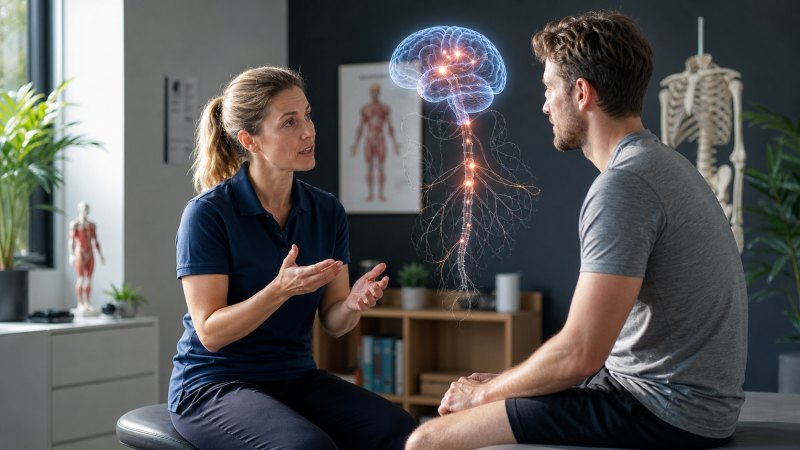
Schmerzen verstehen heißt nicht automatisch Schmerzen behandeln
Schmerz gehört zum Alltag in der Physiotherapie. Patienten kommen mit Beschwerden, Erwartungen und oft auch der Hoffnung auf schnelle Lösungen in die Praxis. Doch genau hier beginnt das eigentliche Problem: Viele Therapeuten arbeiten noch immer mit veralteten Schmerzmodellen, obwohl sich die Wissenschaft längst weiterentwickelt hat. Schmerz ist heute nicht mehr nur als rein mechanisches oder strukturelles Problem zu verstehen. Trotzdem wird in vielen Behandlungen noch genau so gearbeitet – nach klassischen Mustern, Routinen und simplen Ursache-Wirkung-Erklärungen.
Warum alte Denkweisen zum Problem werden
Die moderne Schmerzforschung zeigt, dass Schmerz deutlich komplexer ist als ein „kaputtes Gewebe“. Faktoren wie Erfahrungen, Emotionen, Stress, Schlaf oder Erwartungen beeinflussen die Wahrnehmung massiv. Genau das wird in der Praxis jedoch häufig unterschätzt. Viele Patienten erhalten weiterhin Erklärungen, die Angst verstärken statt Sicherheit zu geben. Aussagen wie „die Bandscheibe ist raus“ oder „das Gelenk ist verschlissen“ prägen das Denken der Betroffenen oft langfristig – mit direkten Folgen für Bewegung, Verhalten und Therapieerfolg.
Zwischen Wissenschaft und Praxis klafft eine Lücke
Während wissenschaftliche Erkenntnisse immer stärker biopsychosoziale Faktoren berücksichtigen, bleibt der Transfer in den Praxisalltag schwierig. Der Artikel beschreibt, dass viele Physiotherapeuten zwar wissen, dass Schmerz komplex ist, aber dennoch häufig in alten Erklärungsmustern gefangen bleiben. Das führt dazu, dass Patienten zwar behandelt, aber nicht wirklich verstanden werden. Genau darin liegt laut Beitrag eine der größten Herausforderungen moderner Physiotherapie.
Kommunikation verändert Therapieergebnisse
Besonders spannend ist der Gedanke, dass nicht nur Techniken oder Übungen wirken, sondern auch Sprache. Wie Schmerz erklärt wird, beeinflusst direkt die Wahrnehmung des Patienten. Gute Kommunikation kann Vertrauen schaffen, Angst reduzieren und Bewegung fördern. Schlechte Kommunikation hingegen kann Beschwerden verstärken und Menschen langfristig verunsichern. Damit wird Aufklärung plötzlich zu einem therapeutischen Werkzeug – nicht nur zu einem netten Zusatz.
Der entscheidende Punkt, den viele unterschätzen
Genau hier setzt der Artikel an: Wer Schmerzen erklären will, muss zuerst verstehen, wie moderne Schmerzmechanismen tatsächlich funktionieren. Und genau daran scheitert es häufig im Alltag. Denn zwischen theoretischem Wissen und praktischer Anwendung liegen Unsicherheiten, Routinen und alte Überzeugungen, die tief verankert sind.
Die eigentliche Frage lautet deshalb nicht mehr: „Woher kommt der Schmerz?“ Sondern: „Warum reagiert das System überhaupt mit Schmerz?“
Und genau an dieser Stelle wird der Artikel besonders relevant – denn er zeigt, warum viele klassische Therapieansätze heute nicht mehr ausreichen und welche Denkfehler Physiotherapeuten dringend hinterfragen sollten. Der vollständige Beitrag erklärt, welche modernen Schmerzmodelle du kennen musst, warum Patientenaufklärung oft falsch umgesetzt wird und welche konkreten Auswirkungen das auf deinen Behandlungserfolg hat.
Dein DK Sports & Physio Team aus der Karlsruher Oststadt
Den ausführlichen Artikel findest du in unserer DK Academy.
Wir geben Physiotherapeuten, Trainern und allen Wissbegierigen einen sachlichen Einblick in die Physiotherapie und helfen so die Rehabilitation und das Training nach Verletzungen oder Beschwerden effizienter zu gestalten.
Sichere dir vollen Zugriff auf unsere Rehab Live Sessions, exklusive Review- und Blogartikel, Simple Tipps und Infografiken.

Du benötigst Physiotherapie im Raum Karlsruhe? Dann sind wir gerne für dich da und unterstützen dich!
Dein DK Sports & Physio Team aus der Karlsruher Oststadt
Unsere weiteren Blog-Artikel

Training als Medikament bei Multipler Sklerose?

Vegane Ernährung im Leistungssport – zwischen Planung, Evidenz und Performance
MTSS oder LIMP? Warum wir das „Schienbeinkantensyndrom“ neu denken müssen

Glutenunverträglichkeit – alles nur Kopfsache?

Airex-Kissen & Bosu-Bälle – Spielzeug oder kann das weg?
Warum wir über die Reruptur des Kreuzbandes sprechen müssen

Arroganz in der Physiotherapie? Zwischen Wissen und Gewissheit
Quellenangaben:
[1] T. Reißner und A. Bassimtabar, „Aktueller Wissensstand deutscher Physiotherapeuten zum Thema Schmerz“, Schmerz, Nov. 2024, doi: 10.1007/s00482-024-00846-6.
[2] J. W. S. Vlaeyen, G. Crombez, und S. J. Linton, „The fear-avoidance model of pain“, Pain, Bd. 157, Nr. 8, S. 1588–1589, Aug. 2016, doi: 10.1097/j.pain.0000000000000574.
[3] C. A. Wassinger, „Pain knowledge, attitudes and beliefs of doctor of physical therapy students: changes across the curriculum and the role of an elective pain science course“, J. Man. Manip. Ther., Bd. 29, Nr. 5, S. 288–296, Sep. 2021, doi: 10.1080/10669817.2021.1879509.
[4] T. H. Wideman, J. Miller, G. Bostick, A. Thomas, A. Bussières, und R. H. Wickens, „The current state of pain education within Canadian physiotherapy programs: a national survey of pain educators“, Disabil. Rehabil., Bd. 42, Nr. 9, S. 1332–1338, Mai 2020, doi: 10.1080/09638288.2018.1519044.
[5] R. J. Scudds, R. A. Scudds, und M. J. Simmonds, „Pain in the physical therapy (pt) curriculum: a faculty survey“, Physiother. Theory Pract., Bd. 17, Nr. 4, S. 239–256, Jan. 2001, doi: 10.1080/095939801753385744.
[6] „A mechanistic approach to pain management: Applying the biopsychosocial model to physical therapy“, A mechanistic approach to pain management: Applying the biopsychosocial model to physical therapy. [Online]. Verfügbar unter: https://www.iasp-pain.org/publications/relief-news/article/mechanistic-pain-management-biopsychosocial-model/
[7] G. P. G. Lemmers, J. D. Bier, W. van Lankveld, G. P. Westert, J. B. Staal, und P. J. van der Wees, „Guideline adherence of physiotherapists in the treatment of patients with low back pain: A qualitative study“, J. Eval. Clin. Pract., Bd. 28, Nr. 6, S. 1147–1156, Dez. 2022, doi: 10.1111/jep.13703.
[8] M. Rabey, H. Slater, C. Hebron, und N. Moloney, „Societal beliefs about pain may be more balanced than previously thought. Results of the Guernsey pain survey“, BMC Musculoskelet. Disord., Bd. 25, Nr. 1, S. 72, Jan. 2024, doi: 10.1186/s12891-023-07088-0.
[9] C. Adillón, È. Lozano, und I. Salvat, „Comparison of pain neurophysiology knowledge among health sciences students: a cross-sectional study“, BMC Res. Notes, Bd. 8, Nr. 1, S. 592, Dez. 2015, doi: 10.1186/s13104-015-1585-y.
[10] A. C. Traeger u. a., „Effect of Intensive Patient Education vs Placebo Patient Education on Outcomes in Patients With Acute Low Back Pain: A Randomized Clinical Trial“, JAMA Neurol., Bd. 76, Nr. 2, S. 161–169, Feb. 2019, doi: 10.1001/jamaneurol.2018.3376.
[11] P. H. Duhn u. a., „Effectiveness of patient education as a stand-alone intervention for patients with chronic widespread pain and fibromyalgia: a systematic review and meta-analysis of randomized trials“, Scand. J. Rheumatol., Bd. 52, Nr. 6, S. 654–663, Nov. 2023, doi: 10.1080/03009742.2023.2192450.
[12] J. Althoff, „Briefe an Lauterbach – Weltverband mahnt Physio-Akademisierung an“, BODYMEDIA Fachmagazin. Zugegriffen: 8. Mai 2025. [Online]. Verfügbar unter: https://www.bodymedia.de/news/briefe-an-lauterbach-weltverband-mahnt-physio-akademisierung-an/
[13] „PhysTh-APrV – Ausbildungs- und Prüfungsverordnung für Physiotherapeuten“. Zugegriffen: 8. Mai 2025. [Online]. Verfügbar unter: https://www.gesetze-im-internet.de/physth-aprv/BJNR378600994.html
[14] P. O’Sullivan, „It’s time for change with the management of non-specific chronic low back pain“, Br. J. Sports Med., Bd. 46, Nr. 4, S. 224–227, März 2012, doi: 10.1136/bjsm.2010.081638.
[15] C. B. Oliveira u. a., „Clinical practice guidelines for the management of non-specific low back pain in primary care: an updated overview“, Eur. Spine J., Bd. 27, Nr. 11, S. 2791–2803, Nov. 2018, doi: 10.1007/s00586-018-5673-2.
[16] J. Nijs u. a., „Low back pain: guidelines for the clinical classification of predominant neuropathic, nociceptive, or central sensitization pain“, Pain Physician, Bd. 18, Nr. 3, S. E333-346, 2015.
[17] B. Darlow, A. Dowell, G. D. Baxter, F. Mathieson, M. Perry, und S. Dean, „The enduring impact of what clinicians say to people with low back pain“, Ann. Fam. Med., Bd. 11, Nr. 6, S. 527–534, 2013, doi: 10.1370/afm.1518.
[18] G. Rossettini, E. M. Camerone, E. Carlino, F. Benedetti, und M. Testa, „Context matters: the psychoneurobiological determinants of placebo, nocebo and context-related effects in physiotherapy“, Arch. Physiother., Bd. 10, S. 11, 2020, doi: 10.1186/s40945-020-00082-y.
[19] M. O’Keeffe u. a., „What Influences Patient-Therapist Interactions in Musculoskeletal Physical Therapy? Qualitative Systematic Review and Meta-Synthesis“, Phys. Ther., Bd. 96, Nr. 5, S. 609–622, Mai 2016, doi: 10.2522/ptj.20150240.
[20] N. Javdaneh, A. H. Saeterbakken, A. Shams, und A. H. Barati, „Pain Neuroscience Education Combined with Therapeutic Exercises Provides Added Benefit in the Treatment of Chronic Neck Pain“, Int. J. Environ. Res. Public. Health, Bd. 18, Nr. 16, S. 8848, Aug. 2021, doi: 10.3390/ijerph18168848.
[21] S. P. Tatikola, V. Natarajan, S. K. Amaravadi, V. K. Desai, A. R. Asirvatham, und R. Nagaraja, „Effect of pain neuroscience education+ (PNE+) in people with different mechanisms of chronic pain: A systematic review and meta-analysis“, J. Bodyw. Mov. Ther., Bd. 41, S. 215–237, März 2025, doi: 10.1016/j.jbmt.2024.11.016.
[22] J. Salazar-Méndez u. a., „Pain neuroscience education for patients with chronic pain: A scoping review from teaching–learning strategies, educational level, and cultural perspective“, Patient Educ. Couns., Bd. 123, S. 108201, Juni 2024, doi: 10.1016/j.pec.2024.108201.
[23] G. L. Moseley, „Reconceptualising pain according to modern pain science“, Phys. Ther. Rev., Bd. 12, Nr. 3, S. 169–178, Sep. 2007, doi: 10.1179/108331907X223010.
[24] P. H. Duhn u. a., „Effectiveness of patient education as a stand-alone intervention for patients with chronic widespread pain and fibromyalgia: a systematic review and meta-analysis of randomized trials“, Scand. J. Rheumatol., Bd. 52, Nr. 6, S. 654–663, Nov. 2023, doi: 10.1080/03009742.2023.2192450.
[25] J. Nijs u. a., „In the spine or in the brain? Recent advances in pain neuroscience applied in the intervention for low back pain“, Clin. Exp. Rheumatol., Bd. 35 Suppl 107, Nr. 5, S. 108–115, 2017.
[26] C. E. Argoff, „Evidence-based patient-centered pain management and the American Academy of Pain Medicine“, Pain Med., Bd. 26, Nr. 5, S. 229–230, Mai 2025, doi: 10.1093/pm/pnaf021.
[27] I. Lin u. a., „What does best practice care for musculoskeletal pain look like? Eleven consistent recommendations from high-quality clinical practice guidelines: systematic review“, Br. J. Sports Med., Bd. 54, Nr. 2, S. 79–86, Jan. 2020, doi: 10.1136/bjsports-2018-099878.
[28] P. Hutchinson und D. E. Moerman, „The Meaning Response, ‚Placebo,‘ and Methods“, Perspect. Biol. Med., Bd. 61, Nr. 3, S. 361–378, 2018, doi: 10.1353/pbm.2018.0049.
[29] R. Parker und V. J. Madden, „State of the art: What have the pain sciences brought to physiotherapy?“, South Afr. J. Physiother., Bd. 76, Nr. 1, Feb. 2020, doi: 10.4102/sajp.v76i1.1390.
[30] J. E. Bialosky, M. D. Bishop, D. D. Price, M. E. Robinson, und S. Z. George, „The mechanisms of manual therapy in the treatment of musculoskeletal pain: a comprehensive model“, Man. Ther., Bd. 14, Nr. 5, S. 531–538, Okt. 2009, doi: 10.1016/j.math.2008.09.001.
[31] N. E. Foster u. a., „Prevention and treatment of low back pain: evidence, challenges, and promising directions“, Lancet Lond. Engl., Bd. 391, Nr. 10137, S. 2368–2383, Juni 2018, doi: 10.1016/S0140-6736(18)30489-6.
[32] P. O’Sullivan, „Diagnosis and classification of chronic low back pain disorders: maladaptive movement and motor control impairments as underlying mechanism“, Man. Ther., Bd. 10, Nr. 4, S. 242–255, Nov. 2005, doi: 10.1016/j.math.2005.07.001.